
Best Jet Ski Docks for keeping a personal watercraft (PWC) safe require more than a cleat and hope. True protection pairs the right dock or lift, durable materials, and an installation that accounts for local coastal conditions. This guide explains what “ultimate protection” looks like for jet skis, why Gulf Coast conditions demand specific solutions, and how to choose a dock that fits your use and budget. MacDuff Marine is included here as a local resource — an authorized Wave Armor dealer with hands-on installations across Southwest Florida — but our goal is to help you pick long-term protection for your PWC. Read on to compare floating ports, drive-on systems, traditional lifts, and modular setups; evaluate key features like HDPE/polyethylene construction, hull-interface design, and UV resistance; and see which Wave Armor PRO PORT models fit popular PWCs. By the end you’ll have a practical checklist and a clear idea of when to request professional installation in Lee, Charlotte, Sarasota, Collier, DeSoto, and Polk counties.
Why proper protection matters for your jet ski
Protecting your PWC preserves the hull, cuts routine maintenance, and keeps the craft ready to ride. The right storage method keeps the hull out of the water or on cushioned supports, reduces abrasion, and resists UV and saltwater damage. That protection lowers repair bills, preserves resale value, and reduces problems like osmosis, gelcoat chips, and engine-room salt exposure. Professional installation aligns mount points, flotation, and tie-downs with local water movement so parts aren’t repeatedly stressed. For Southwest Florida owners, an on-site assessment and correct setup significantly reduce the chance a system fails during storms or tidal shifts. Those factors are essential when choosing the best jet ski docks.
- Key benefits of proper PWC protection include: Hull preservation: Reduces abrasion and prolonged water exposure that accelerate wear.Lower maintenance: Limits biofouling and corrosion-related repairs.Operational readiness: Keeps your PWC secure and launch-ready whenever you want to ride.
Those benefits guide decisions about dock type and materials; understanding how protection works makes it easier to see why some systems perform better on the Gulf Coast and helps you identify the best jet ski docks for your situation.
How a jet ski dock prevents hull damage and UV degradation
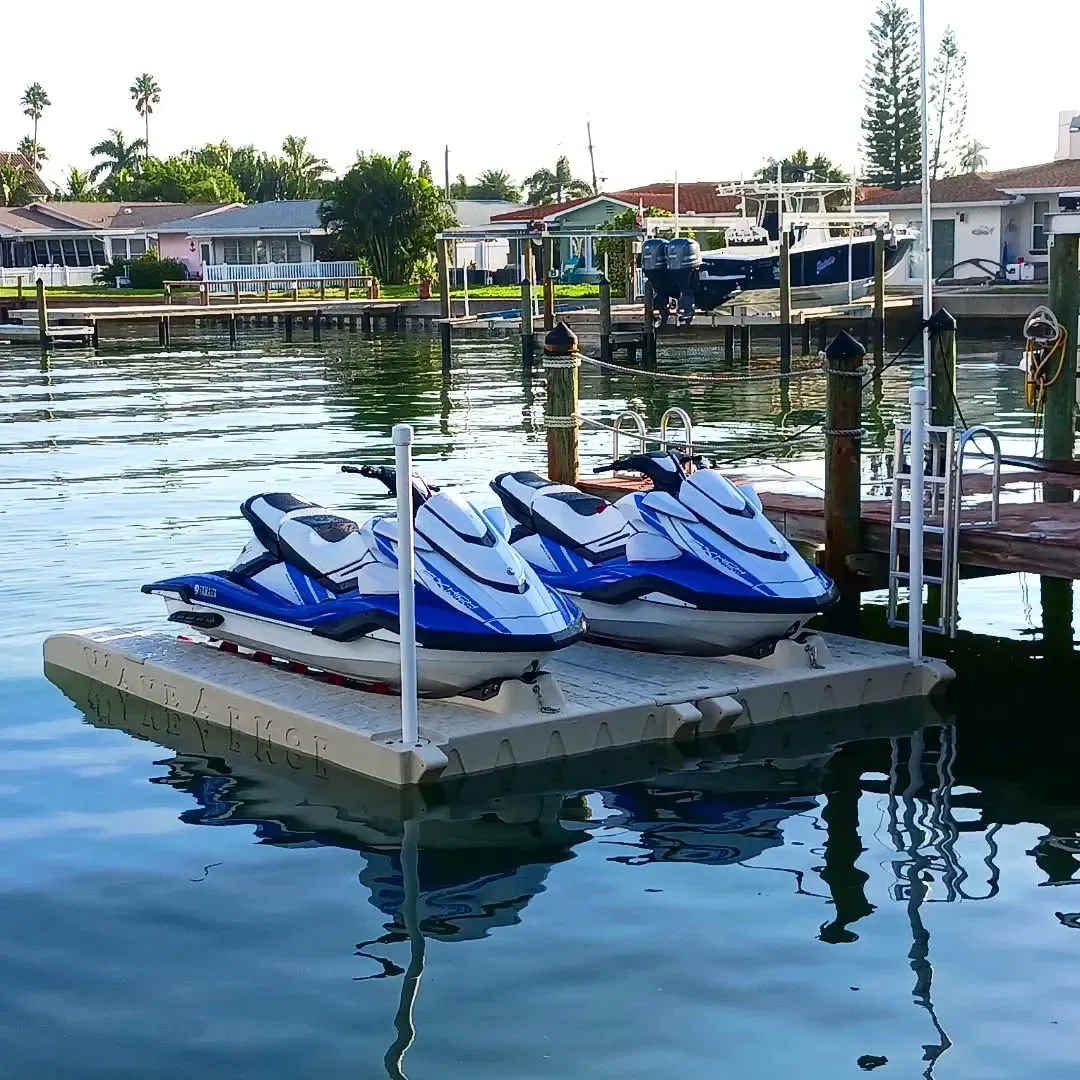
A proper jet ski dock either lifts or cradles the craft so it spends less time in the water and is shielded from floating debris, scraping, and constant salt exposure. Mechanical lifts use winches or hydraulics to raise the PWC, while floating ports support hulls on polyethylene modules with shaped cradles that spread weight and avoid pressure points. UV exposure is limited by UV-stabilized materials — especially HDPE/polyethylene floats and UV-resistant bumpers — which slow polymer breakdown. Rollers and soft pads let the craft move smoothly during launch and retrieval instead of scraping hard surfaces. These choices reduce blisters, gelcoat cracks, and delamination over time, protect resale value, and lower long-term ownership costs. Knowing these protection methods helps when you compare dock types to find the best jet ski docks.
Environmental challenges for PWCs in Southwest Florida
Southwest Florida exposes PWCs to intense sun, warm saltwater that speeds corrosion, episodic storm surge and waves, and fast marine growth on submerged parts. High salinity increases galvanic stress on metal hardware, and strong sun degrades unprotected plastics and rubber faster than in cooler climates. Storm debris and surge can displace poorly anchored floating systems, so secure mounting and proper freeboard are critical. Marine growth raises cleaning needs; systems that lift the hull out of the water or use low-fouling materials reduce those chores and keep intakes clearer. Practical mitigation includes choosing UV-stable HDPE modules, corrosion-resistant hardware or sacrificial anodes where metal is exposed, and a dock design that accounts for local tidal ranges and surge. Those choices should steer your dock type selection and whether you need a site-specific professional installation for the best jet ski docks.
Main types of jet ski docks — and what each does best
Jet ski docking options fall into four practical groups: floating ports, drive-on ports/drive-on lifts, traditional PWC lifts, and modular systems. Each fits different water depths, exposure levels, and owner preferences. Floating ports are passive, buoyant platforms that support the hull near the waterline with low upkeep; drive-on systems let you quickly drive on and off; traditional lifts raise the craft out of the water for maximum protection; and modular systems let you create custom layouts for unique shorelines. The right pick depends on depth, exposure, how many PWCs you store, and whether convenience or full dry storage is the priority. For broader solutions, see our boat ports and boat lift systems.
- Common selection factors for the best jet ski docks include:
- Usage frequency: Daily riders often prefer drive-on ports for quick launches.
- Exposure level: High-exposure sites typically need mechanical lifts or heavily anchored floating setups.
- Maintenance tolerance: Owners wanting low upkeep usually choose HDPE floating ports or drive-on systems with antifouling contact points.
This framework makes it easier to match a dock type to your waterfront and priorities, guiding you to the best jet ski docks for your needs.
Different dock types compared for practical decision-making:
| Dock Type | Construction / Material | Protection Mechanism | Ease of Use | Maintenance |
|---|---|---|---|---|
| Floating PWC Ports | HDPE buoyancy modules, polyethylene decking | Keeps hull supported near surface, soft contact pads | High — simple tie and retrieve | Low — UV-stable plastics resist fouling |
| Drive-On Ports / Drive-On Lifts | Buoyancy modules with ramp or shallow cradle | Drive-on support removes hard docking impacts | Very high — fastest launch/retrieve | Moderate — cradle pads need periodic inspection |
| Traditional PWC Lifts | Aluminum or galvanized steel frames with rollers or cradle | Raises craft fully out of the water | Moderate — mechanical operation required | Moderate–high — metal parts need corrosion checks |
| Modular Systems | Interlocking HDPE or composite parts | Custom configurations for irregular sites | Variable — depends on layout | Low–medium — individual parts are easy to replace |
This side-by-side view helps you match approach to waterfront and priorities; next we’ll cover the protective features to prioritize when choosing the best jet ski docks.
Features to look for in floating jet ski docks
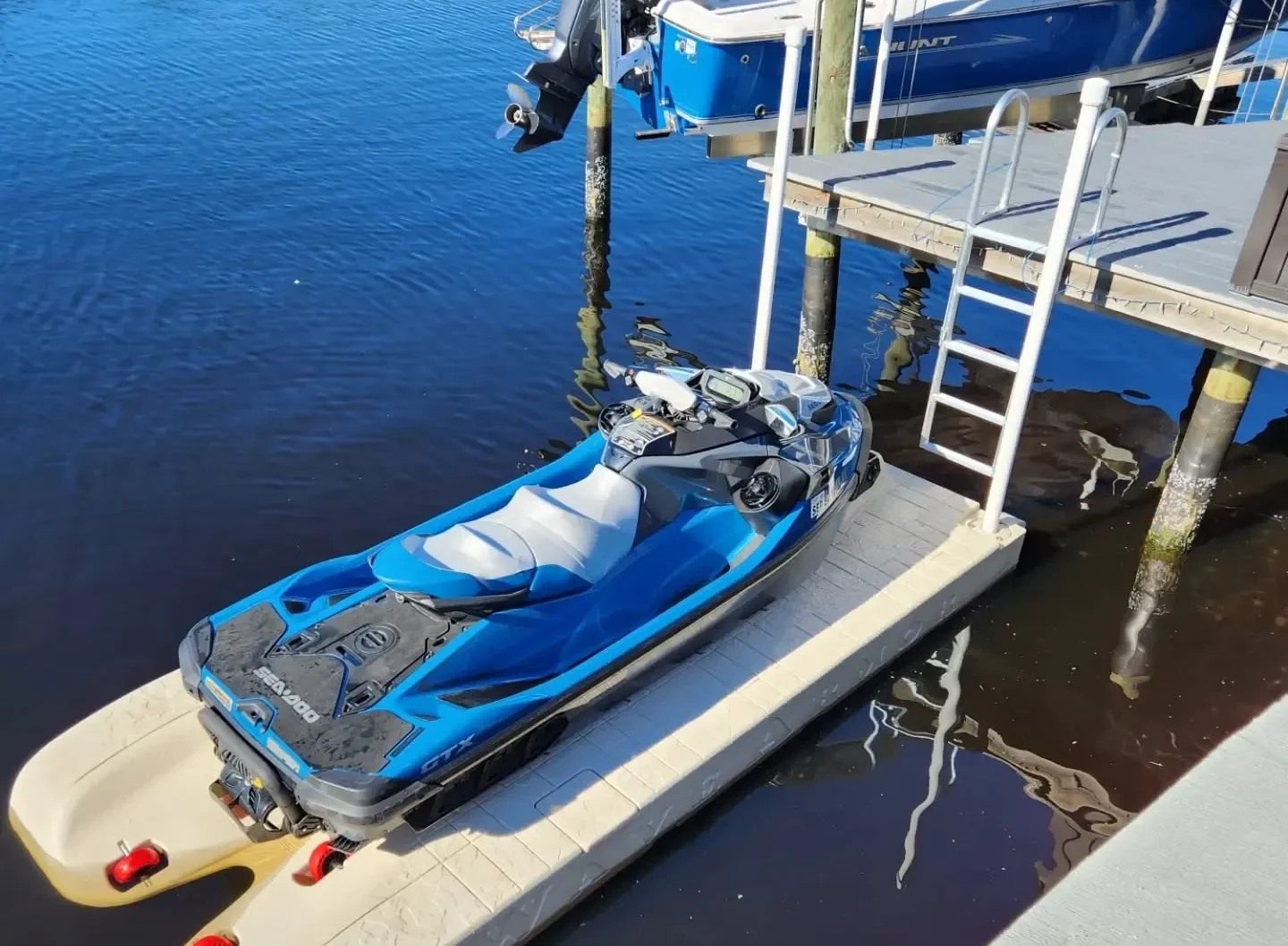
The best floating jet ski docks combine tough materials, well-designed hull interfaces, and stability-focused layouts to reduce wear and keep your craft safe. Look for HDPE (polyethylene) floats with UV stabilizers, shaped cradles or soft-pad systems that spread load, secure tie-down points, and enough width for lateral stability. Built-in anti-abrasion pads and gentle entry ramps lower impact stress during retrieval, while modular connectors let you adapt to changing water levels. Security features like locking cleats and easy access for maintenance complete the package. Consider adding dock accessories to improve functionality.
- Top protective features to prioritize for the best jet ski docks: UV-stable HDPE floats: Stand up to sun and salt without breaking down.Shaped cradles or soft pads: Evenly distribute hull load and prevent pressure points.Stability-enhancing width and buoyancy distribution: Reduce listing and sudden shifts.
Reviewing these features naturally leads to why HDPE performs well and which design choices improve long-term results for the best jet ski docks.
| Feature | How it protects | Example / Metric |
|---|---|---|
| HDPE Buoyancy Modules | Resist UV and saltwater, keep buoyancy consistent | Long service life with minimal upkeep |
| Soft Pad Cradles | Spread load, prevent hard-surface abrasion | Reduces gelcoat wear during docking |
| Modular Connectors | Allow repositioning for changing water levels | Simplifies reconfiguration after seasonal shifts |
Why polyethylene improves dock longevity
High-density polyethylene (HDPE) extends dock life because it combines UV resistance, impact toughness, and low water absorption — it won’t swell or weaken. HDPE attracts less marine growth than many painted surfaces, so hull-contact zones and buoyancy modules stay cleaner and need less scraping or chemicals. Unlike painted metal, HDPE doesn’t corrode and retains buoyancy after repeated impacts, cutting replacement costs. These material traits lower lifecycle maintenance and keep hull support consistent over time. Choosing UV-stabilized polyethylene and pairing it with corrosion-resistant hardware where metal is unavoidable delivers predictable performance and fewer service interruptions — an excellent match for the best jet ski docks.
Design elements that improve stability and usability
Stability comes from wider beams, well-distributed buoyancy, and low center-of-gravity placements for tie-downs — each reduces roll and pitch during boarding or storage. Usability features include non-slip ramps, grab handles, alignment guides for self-centering, and accessible tie-down cleats for quick securement. Modular interlocks and tapered entry ramps make single-person launches safer and reduce the need for help. Inspect these cues in person or on spec sheets to confirm how a floating port will behave in wind, current, and wakes. Good design choices improve safety and convenience over the long haul and should weigh heavily in any purchase decision for the best jet ski docks. See our gallery for real installations.
Why Wave Armor PWC Ports are a top choice
Wave Armor PWC ports are purpose-built floating drive-on solutions that focus on hull protection, low maintenance, and modular flexibility — qualities that suit many Gulf Coast needs. Their polyethylene designs use shaped cradles and gentle entry angles to reduce abrasion, and the product line includes models with different widths and load capacities to fit most PWCs. As an authorized Wave Armor dealer, MacDuff Marine recommends the line for owners who want durable floating ports backed by manufacturer warranty. Wave Armor products assemble straightforwardly and rely on passive protection instead of complex mechanical parts that can fail. That makes it easier to match dimensions and warranty expectations to your PWC and get the best jet ski docks for your situation. Read customer reviews to see owner experiences.
Below is a concise comparison to match Wave Armor ports to typical PWC sizes and use cases.
| Model | Width / Length | Max PWC Size | Material | Protection Features | Warranty |
|---|---|---|---|---|---|
| PRO PORT 5′ | Approx. 5′ wide, 10′ long | Single standard PWC | HDPE modules | Shaped cradle, soft pads | 8-year product warranty |
| PRO PORT 6′ | Approx. 6′ wide, 10′ long | Most single PWCs, larger hulls | HDPE modules | Wider cradle, enhanced stability | 8-year product warranty |
| PRO Wide Body | Approx. 7′ wide, 10′ long | Wide/higher-displacement PWCs | HDPE modules | Broad support, extra flotation | 8-year product warranty |
Key benefits of the Wave Armor PRO PORT series
The PRO PORT series combines gentle drive-on geometry, HDPE flotation modules, and modular assembly that makes staging and seasonal storage straightforward. Shaped cradles and soft-contact surfaces reduce gelcoat wear during retrieval, while the modular build lets owners adapt to water-level changes or different craft. HDPE’s low-maintenance nature cuts cleaning and repair time, and fewer mechanical parts means fewer service needs. Wave Armor’s warranty backing sets clear expectations for product life and performance. For recreational owners who want protective, low-maintenance storage without the complexity of mechanical lifts, PRO PORTs are among the best jet ski docks available.
How PRO PORT 5′ and PRO Wide Body differ
The PRO PORT 5′ fits standard single PWCs and works well in tighter slips, offering efficient drive-on retrieval with a smaller footprint. The PRO Wide Body supports wider, heavier-displacement PWCs with broader contact and extra flotation for improved lateral stability in wind. Choose by measuring your PWC’s beam and planform and matching those numbers to port width and cradle shape so the hull bears weight evenly instead of edge-loading. Understanding these dimensional trade-offs helps you pick the right model for your craft and dock space, ensuring you select the best jet ski docks for your needs.
How to choose the best jet ski docks for your property
Start with a site-focused assessment: water depth, exposure, tidal range, and local wind patterns. Match those realities to the protection features you need. Daily riders usually prioritize drive-on convenience; seasonal owners often prefer lifts that remove PWCs from the water. A budget analysis should compare upfront cost to lifecycle maintenance and warranty coverage. Finally, have a local installer survey the site so anchors, freeboard, and alignment meet safety and durability needs. For multi-sport properties, consider kayak lift ladders as complementary options.
- Quick selection checklist to guide purchase of the best jet ski docks: Measure water depth and tidal range: Confirms compatibility with drive-on or lift types.Assess exposure (wind, fetch, surge): Steers you toward anchored floating ports or mechanical lifts.Inventory PWC fleet and usage frequency: One-off users and daily riders need different access solutions.
These steps create a clear decision path leading to installation and service planning. For more on costs, see our blog on dock construction costs.
Factors that should influence your dock choice
Practical factors include minimum water depth at low tide, prevailing wind and wave conditions, how many and what size PWCs you’ll store, and the balance you want between convenience and full dry storage. Measure minimum depth at the proposed slip, lateral clearance, and the shore access grade for installation equipment. Factor in maintenance and replacement costs — polymer-module systems with limited exposed metal typically have lower lifecycle expenses. These diagnostics help match the dock type (floating port, drive-on, lift) to the site and your priorities, ensuring you select the best jet ski docks. Other reputable manufacturers include ShoreMaster, HydroHoist, SunDock, and FLOE International.
A systematic measurement and usage checklist reduces the risk of choosing an incompatible system and highlights when a professional site visit is needed. Always consult U.S. Coast Guard Boating Safety guidance and ABYC Standards for safety.
Why professional installation matters in Southwest Florida
Local tide swings, storm surge potential, and seabed conditions require custom anchoring, correct elevation, and suitable hardware for long-term performance. Professional installers assess the seafloor, recommend corrosion-resistant attachments, and set tie-downs and flotation to minimize repetitive stress. MacDuff Marine offers local installation across Lee, Charlotte, Sarasota, Collier, DeSoto, and Polk counties, plus same-day local service, flexible scheduling, a 15-year warranty on boat lifts, and an 8-year warranty on Wave Armor products — firm guarantees that reduce project risk. We also back a price-beat promise: where applicable, we’ll beat any written estimate by $150. Hiring a qualified installer yields a documented site plan, properly aligned hardware, and installation records that preserve warranties and protect your investment. Those procedural safeguards complete the path from selection to secure, long-lasting PWC storage, ensuring you get the best jet ski docks installed correctly. For installation tips, see resources like PWC Docking Setup and Dock Anchoring Techniques.
Request a Free Estimate Today!
Ready to find your best jet ski dock?
Don’t compromise on PWC protection. Let our team help you choose and install the right jet ski dock for your Southwest Florida property.
Frequently asked questions about the best jet ski docks
What maintenance is required for jet ski docks?
Maintenance depends on dock type. Expect regular inspections for wear, routine cleaning to control marine growth, and checks on mechanical parts. Floating ports generally need less hands-on care, while traditional lifts require more frequent metal inspections and lubrication. Always check tie-downs and flotation components for security and follow the manufacturer’s maintenance schedule to preserve performance and warranty coverage. For general care, see Dock Maintenance guides and Winterization Guidelines.
How can I ensure my jet ski dock is secure during storms?
Storm readiness starts with proper anchoring and components rated for local conditions. Use heavy-duty tie-downs and consider extra anchors or supplemental weights for exposed sites. Inspect the system before storm season and confirm freeboard is adequate for surge. For high-risk locations, consult a professional installer for site-specific reinforcement and a storm plan. Following NMMA and International Marina Institute recommendations can also help.
What are the advantages of using modular dock systems?
Modular systems are flexible and easy to reconfigure as water levels or needs change. You can expand, rearrange, or replace sections without a full rebuild, and interlocking parts simplify installation and repairs. That adaptability can save money over time and make seasonal adjustments straightforward, making them a strong contender for the best jet ski docks in dynamic environments.
Are there eco-friendly options for jet ski docks?
Yes. Look for docks made from recycled or recyclable HDPE and designs that limit impact on local habitats by allowing natural water flow and preventing erosion. HDPE’s resistance to marine growth also reduces the need for chemical cleaners. Choose manufacturers that prioritize sustainability and check product materials and disposal options. Consult EPA Water Quality standards, State Waterway Regulations, and Marina Permitting information. Also consider the environmental impact of your choices.
How do I choose the right size dock for my jet ski?
Measure your PWC’s length, beam, and weight, and confirm the dock’s capacity and cradle geometry will support the hull evenly. Allow room for maneuvering and consider the available slip width. If you’re unsure, have a professional verify dimensions and recommend a fit to avoid edge-loading or insufficient support. That ensures you get the best jet ski docks for your craft.
What should I consider when installing a jet ski dock?
Consider water depth, tidal range, prevailing weather, and substrate for anchoring. Position the dock to minimize exposure to currents and waves, use corrosion-resistant hardware where possible, and ensure shore access for installation equipment. A professional installer can confirm site suitability and align the dock for reliable, long-term performance, protecting your investment in the best jet ski docks. The BoatUS Foundation has useful resources for boat owners.
Can I install a jet ski dock myself, or should I hire a professional?
Some experienced DIYers can install simpler floating systems, but hiring a professional is recommended for site assessments, anchoring in challenging substrates, and warranty-compliant installations. Professionals bring local knowledge, proper equipment, and documentation that protects your investment and ensures safe, durable results — especially when installing the best jet ski docks in challenging Southwest Florida conditions.