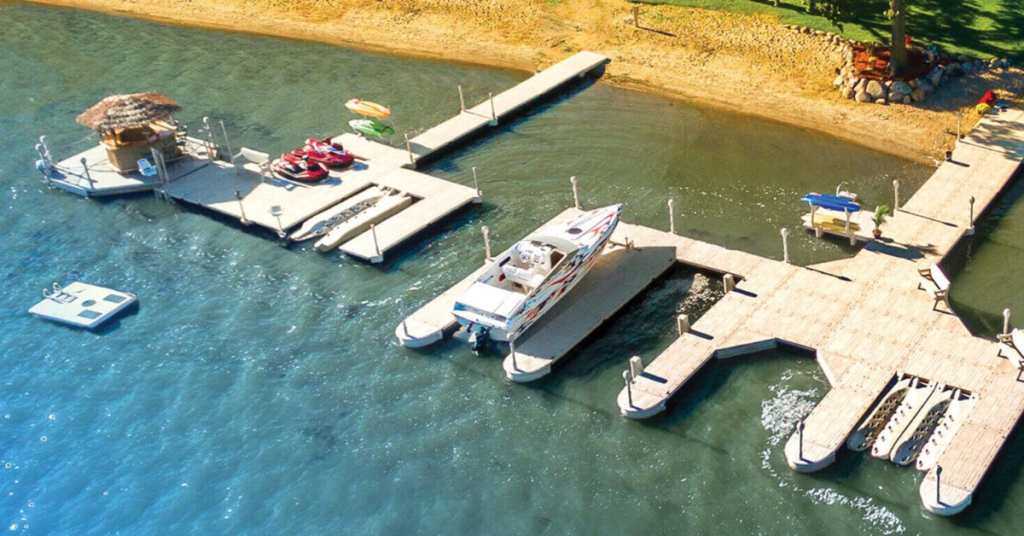
A floating dock can change how a Florida waterfront works. Instead of maintaining one fixed elevation while the water moves beneath it, the dock rises and falls with the water, creating a platform that can be configured around boating, personal watercraft, kayaks, swimming and everyday waterfront access.
MacDuff Marine is an authorized Wave Armor dealer serving Southwest Florida. Wave Armor's modular dock system uses rotomolded polyethylene dock sections, foam-filled flotation and H-Beam connections that allow different sections and compatible waterfront products to be planned as one system.
This guide explains what Wave Armor floating docks are, how they are constructed, what they can connect to, what maintenance and warranty coverage actually look like, and what Florida property owners should consider before planning an installation.

What Is a Wave Armor Floating Dock?
Wave Armor Wave Docks are modular floating dock systems designed for residential and commercial applications in both fresh and saltwater environments.
Instead of building the entire walking surface as one permanent structure, the system uses individual rotomolded dock sections that can be joined together in different sizes and orientations.
Floating
The dock follows changing water levels rather than remaining at one fixed elevation above the water.
Modular
Individual sections can be connected to create straight runs, turns, slips, platforms and other layouts based on the property.
Expandable
Compatible ports, kayak access, accessories and additional dock sections can be incorporated when the layout and mounting system allow.
What Are Wave Armor Dock Sections Made From?
Current Wave Armor dock sections use UV-protected rotomolded polyethylene and a two-piece construction consisting of the upper deck and a foam-filled lower float.
Rotomolded Polyethylene
The main dock components are molded from polyethylene rather than using a traditional wood walking surface.
Foam-Filled Lower Float
The lower portion of the section contains marine-grade foam as part of the dock's flotation design.
Flagstone-Style Surface
The upper deck uses Wave Armor's molded flagstone-style texture rather than a traditional plank pattern.
Wave Armor also molds attachment slots and H-Beam connection channels into its dock sections so compatible sections and accessories can be incorporated without treating every addition as a separate waterfront structure.
How Do Wave Armor Dock Sections Connect Together?
Wave Armor uses polyethylene H-Beams that slide into channels molded into compatible dock sections.
Different H-Beam lengths are used for different connection arrangements, including side-to-side and end-to-end connections. Wave Armor describes the system as providing both rigidity and flexibility while creating a connected dock surface.
Homeowners can explore current sections and sample configurations with the official Wave Armor Dock Builder .
Why Floating Docks Can Work Well on Florida Waterfronts
Florida waterfronts vary considerably. A Cape Coral canal, Fort Myers riverfront home, freshwater property and protected marina slip can all have different water levels, exposure, access and mounting requirements.
Changing Water Levels
A floating platform follows changes in water elevation, which can keep the relationship between the walking surface and water more consistent.
No Wood Walking Surface
The rotomolded deck surface eliminates maintenance tasks that apply specifically to traditional wood decking, such as staining and sealing the deck boards.
Saltwater and Freshwater Applications
Wave Armor identifies its Wave Dock system for both freshwater and saltwater applications.
Can Wave Armor Floating Docks Include PWC Ports?
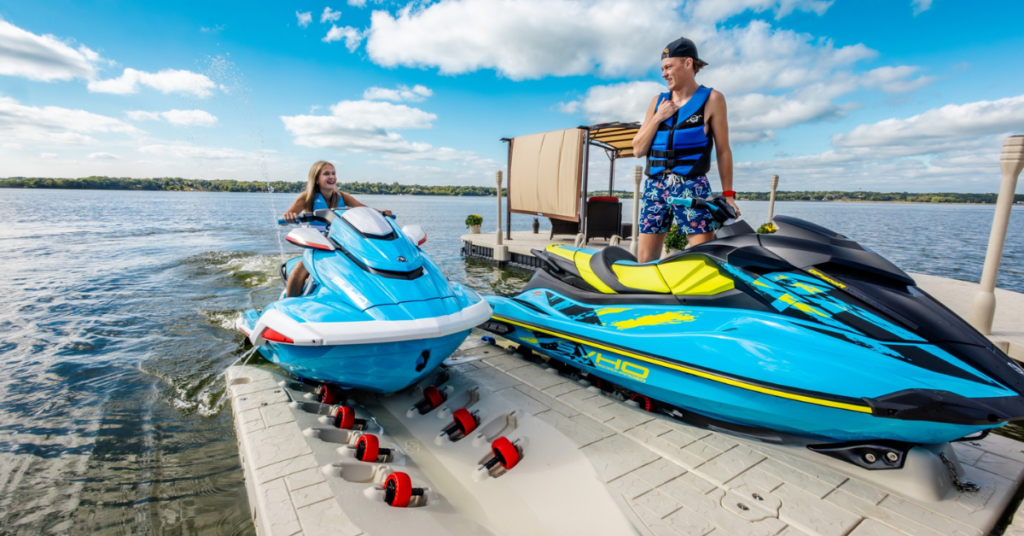
Yes. One of the practical advantages of using one manufacturer ecosystem is the ability to plan personal watercraft storage together with the larger dock layout.
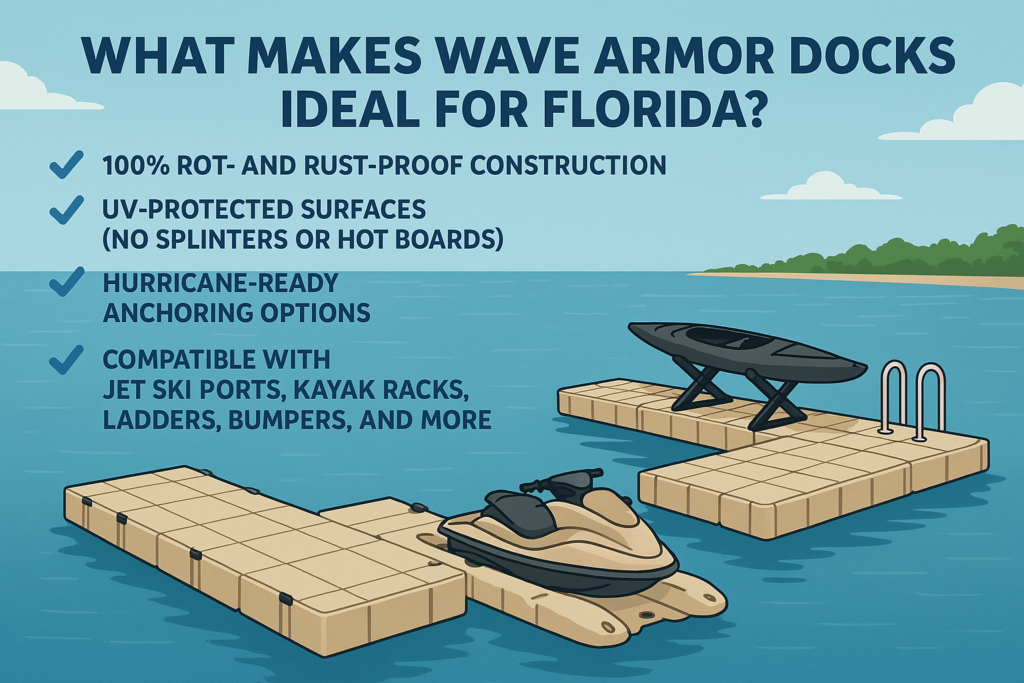
Wave Armor manufactures several drive-on PWC port configurations that can connect to compatible Wave Dock systems.
The best layout depends on the number of PWCs, their dimensions and weight, the approach from the water, and how much walking room is needed around the ports.

Wave Armor Also Supports Pontoon, Boat and Paddlecraft Access
A modular dock becomes more useful when it is planned around the watercraft the property actually uses.
Pontoon Ports
Wave Armor offers drive-on pontoon-port systems for compatible pontoon applications.
Boat Ports
Floating boat-port systems are available for compatible vessel applications and can be incorporated into broader waterfront layouts.
Kayak Access
Dedicated kayak and canoe launch products create a lower access point specifically for paddlecraft.
A Floating Dock Can Be Planned Around a Pontoon
Pontoon storage is different from simply tying a pontoon beside a walking platform.
Wave Armor's pontoon-port system provides a dedicated drive-on floating storage option for compatible pontoons. When the port is part of a larger waterfront plan, surrounding dock sections can provide boarding and walking access around the craft.
MacDuff Marine can evaluate the pontoon, waterfront dimensions and existing structures before determining whether a floating pontoon-port approach fits the property.
Explore current boat and pontoon port options .


Add Dedicated Kayak and Canoe Access
A general walking platform and a purpose-built paddlecraft launch solve different problems.
Wave Armor's kayak launch creates a lower access point for launching and recovering kayaks and canoes. It can be incorporated into compatible waterfront layouts where paddlecraft use is an important part of the property.
Storage can also be planned separately with compatible dock accessories such as kayak racks.
What Accessories Can Be Added to a Wave Armor Dock?
Wave Armor's current system includes a substantial accessory lineup, allowing the main dock to be planned around how the waterfront will actually be used.
Storage
Dock boxes, bench storage and racks can help keep frequently used equipment off the main walking surface.
Water Access
Ladders, steps and lower-access components can be incorporated around swimming and boarding needs.
Dock Hardware
Compatible cleats, bumpers, post components and connection products can be selected for the planned configuration.
Lighting
Compatible lighting products can help define dock edges and access areas in lower-light conditions.
Seating
Bench and seating options can make a wider dock platform function as an outdoor waterfront space.
Kayak Storage
Dedicated rack systems can separate paddlecraft storage from the actual launch area.
Browse MacDuff Marine's current dock accessories .
How Is a Floating Dock Kept in Place?
Floating does not mean unsecured.
The dock still needs a mounting or anchoring approach selected for the property. Wave Armor's own planning process tells owners to evaluate water depth, bottom composition and changing water levels when choosing how the dock will be secured.
Depending on the application, Wave Armor offers different mounting and anchoring components. The appropriate method depends on the actual waterfront rather than one universal setup.
- Water depth
- Bottom conditions
- Changing water levels
- Existing pilings or fixed structures
- Seawall and shoreline layout
- Watercraft approach
- Overall dock configuration
MacDuff Marine evaluates these conditions as part of planning the installation.
Are Wave Armor Floating Docks Hurricane-Proof?
No floating dock should be sold as hurricane-proof.
Severe weather can create extreme wind, waves, surge, debris impacts, unusual water levels and loads on dock connections and anchoring systems. The outcome of a storm depends on the actual property, installation and conditions, not simply the brand of dock.
Wave Armor's current warranty also excludes damage associated with extreme natural elements, among other exclusions. Warranty length should therefore never be presented as a hurricane-performance guarantee.
Are Wave Armor Docks Maintenance-Free?
We would describe them as lower-maintenance than traditional wood decking, not maintenance-free.
Rotomolded polyethylene eliminates some maintenance tasks associated specifically with wood, but the dock is still waterfront equipment.
- Clean the dock surface as needed.
- Inspect visible connections and hardware periodically.
- Check mounting and anchoring components.
- Remove accumulated debris where appropriate.
- Inspect the system after unusual impacts or weather conditions.
- Follow manufacturer instructions for ports and accessories.
Wave Armor maintains a product instruction library for current docks, ports and accessories.
What Is the Warranty on Wave Armor Floating Docks?
The warranty depends on which part of the system you are talking about.
Floating Docks
Wave Armor currently lists a 10-year residential warranty period for floating docks.
Watercraft Ports
PWC ports, boat ports and pontoon ports currently carry 8-year residential periods.
Connections & Accessories
H-Beam connections, dock anchoring kits and most dock accessories currently carry 2-year residential periods. Solar lights are an exception.
Coverage is subject to Wave Armor's current warranty terms, exclusions and documentation requirements. Review the current Wave Armor warranty policy before making a purchasing decision.
Do Floating Docks Require Permits in Florida?
The answer depends on the property and project.
Florida DEP regulates or reviews many docking facilities and related waterfront activities, while local governments can have their own marine-construction requirements.
Some qualifying activities can fall under exemptions or general permitting pathways, while other projects require additional review. That is why a permit timeline should not be promised from a generic blog article.
Property owners can review Florida DEP dock permitting guidance for official state information.
What Should You Decide Before Requesting a Floating Dock Estimate?
The most useful estimate starts with the property and how the owner expects to use the waterfront.
What Uses the Waterfront?
List the boats, PWCs, kayaks, canoes, paddleboards, swimming areas and other activities the dock needs to support.
What Exists Today?
Photos of the seawall, pilings, fixed dock, shoreline and existing waterfront equipment give useful context.
What Might Change?
Consider whether another PWC, boat port, kayak area or dock section may realistically be added later.
Where Does Water Access Matter?
Think about boarding, launching, swimming and carrying gear rather than only the dock footprint.
What Needs Storage?
Paddlecraft, lines, life jackets and other waterfront equipment may need dedicated storage instead of using walking space.
What Is the Priority?
Tell MacDuff Marine whether the goal is better access, less wood-deck maintenance, more watercraft storage, a larger platform or a combination of needs.
Why Work With MacDuff Marine?
MacDuff Marine is an authorized Wave Armor dealer with more than 15 years of waterfront installation experience in Southwest Florida.
The benefit of working with a dealer that regularly works with the same product family is that the conversation can include the dock sections, mounting approach, PWC ports, boat or pontoon access, kayak access and dock accessories as one waterfront plan.
MacDuff Marine serves Lee, Charlotte, Sarasota, Collier, DeSoto and Polk counties.
You can view completed waterfront projects , read customer reviews , or explore the Southwest Florida service area before requesting an estimate.
Common Questions About Wave Armor Floating Docks
What are Wave Armor floating docks made from?
Current Wave Armor Wave Dock sections use UV-protected rotomolded polyethylene with a two-piece design consisting of an upper deck and foam-filled lower float.
Can Wave Armor docks be used in saltwater?
Wave Armor identifies its current floating dock system for both freshwater and saltwater applications. The final mounting and anchoring approach still needs to match the specific waterfront.
Can a Wave Armor dock be expanded later?
Wave Armor is a modular system. Compatible dock sections can be joined in multiple layouts using its H-Beam connection system. Future expansion still needs to work with the installed mounting, anchoring and available waterfront space.
Can I add Jet Ski or PWC ports?
Yes. Wave Armor manufactures multiple drive-on PWC port configurations that can be incorporated into appropriate floating dock layouts.
Can a Wave Armor dock include kayak access?
Yes. Wave Armor offers dedicated kayak and canoe launch products that can be incorporated into compatible waterfront layouts.
How long is the Wave Armor floating dock warranty?
Wave Armor currently lists a 10-year residential warranty for floating docks. PWC, boat and pontoon ports currently carry 8-year residential periods, while H-Beam connections, anchoring kits and most dock accessories carry 2-year periods. Current manufacturer terms and exclusions apply.
Are Wave Armor docks maintenance-free?
MacDuff Marine does not describe them as completely maintenance-free. Their rotomolded construction eliminates some maintenance associated specifically with wood decking, but dock sections, connections, anchoring systems, ports and accessories still benefit from cleaning and periodic inspection.
Are Wave Armor floating docks hurricane-proof?
No floating dock should be represented as hurricane-proof. Severe weather creates site-specific forces involving wind, waves, surge, debris, connections and anchoring. Preparation should follow the conditions at the property and applicable manufacturer guidance.
Do I need a permit for a floating dock in Florida?
Permit requirements depend on the property, waterbody and project scope. State, water-management-district and local requirements can apply, so the specific project should be reviewed before installation.
Get a Wave Armor Floating Dock Estimate for Your Florida Property
Send MacDuff Marine photos of the waterfront and tell us what boats, PWCs, kayaks, swimming access or other features you want the finished dock to support. We can help determine which Wave Armor layout and components should be considered.


Mooring Whips Complete Buyer’s Guide for Cape Coral and SW Florida

Pontoon Boat Lift Sizing and Selection Guide for Southwest Florida

Seawall Repair and Replacement in Cape Coral and Southwest Florida

Sarasota County Boat Lift & Dock Installation: A Complete 2026 Local Guide