
Wave Armor vs. EZ Dock Comparison
Is Wave Armor better than EZ Dock? Not in every measurable category. Both manufacturers produce legitimate modular polyethylene dock systems with broad product ecosystems. The construction philosophies are different: Wave Armor uses a two-piece dock section with a foam-filled lower float and H-Beam connections, while EZ Dock uses one-piece rotomolded sections with hollow flotation chambers and flexible rubber couplers. For MacDuff Marine projects, we generally recommend Wave Armor because it is the floating dock system we sell, install, configure, and support in Southwest Florida. That is a much stronger reason than making unsupported claims that EZ Dock is inherently weak, short-lived, or unsuitable for Florida.
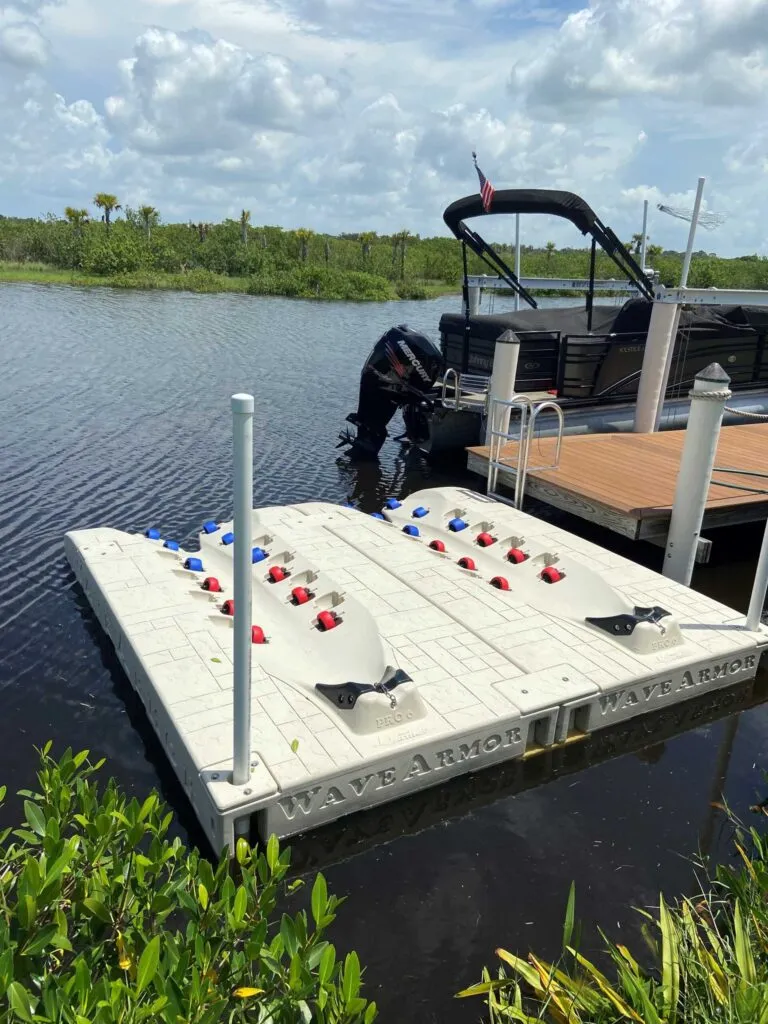
Wave Armor vs. EZ Dock: Key Differences
| Feature | Wave Armor | EZ Dock |
|---|---|---|
| Primary Dock Material | UV-protected rotomolded polyethylene | Rotomolded linear low-density polyethylene |
| Flotation Design | Two-piece section with foam-filled lower float | Foam-free hollow flotation chamber and pylon design |
| Section Connection | Polyethylene H-Beams slide into molded channels | Flexible recycled-rubber couplers with composite hardware |
| Floating Dock Warranty | 8 years residential | 10-year limited warranty |
| Dock Connection Warranty | 2 years for H-Beam connections | 1 year for connection kits |
| Dock Accessory Warranty | Generally 2 years; solar lights are an exception | Generally 1 year |
| PWC Options | Multiple PRO, PRO MAXX, Inline, Sport and SLX configurations | Multiple EZ Port configurations including Inline options |
| Kayak Access | Kayak and canoe dock / launch options | EZ Launch kayak and canoe systems |
| Accessories | Storage, ladders, racks, lighting, cleats, bumpers, seating | Storage, ladders, benches, cleats, bumpers, gangways, rails |
Warranty coverage is controlled by each manufacturer’s current terms, exclusions, documentation requirements, and product category. Always check the specific product being quoted.
Our Recommendation
For a new Southwest Florida project where we are designing the waterfront from the beginning, Wave Armor is normally the system we recommend. If a property already has a functioning EZ Dock system, the decision becomes more project-specific because compatibility, existing investment, condition, and expansion goals all matter.
Foam-Filled vs. Hollow-Chamber Flotation
This is one of the clearest physical differences between the two dock systems.
Two-Piece, Foam-Filled Design
Current Wave Armor Wave Dock sections use a two-piece construction consisting of a rotomolded upper deck and foam-filled lower float.
Wave Armor also incorporates suction pockets into the lower float and molded H-Beam channels into the dock section.
One-Piece, Foam-Free Design
EZ Dock uses rotomolded polyethylene dock sections with hollow flotation chambers rather than foam-filled lower floats.
Its underside pylon design traps air and is designed to provide flotation and stability while the section remains a single integrated structure.
One design should not automatically be labeled superior simply because one uses foam and the other does not. They are different approaches to creating a floating polyethylene platform.
The Connection Systems Work Very Differently
The previous version of this article got this comparison wrong. EZ Dock does not simply use an inflexible rigid connection system.
Sliding Polyethylene Connection
Wave Armor H-Beams slide into molded channels along compatible dock sections. Different H-Beam sizes connect sections side-to-side or end-to-end.
Wave Armor describes the system as providing a solid connection while offering both rigidity and flexibility. View Wave Armor H-Beams
Flexible Rubber Coupling
EZ Dock uses recycled-rubber connection couplers with composite hardware. According to EZ Dock, the couplers allow individual sections to move independently under stress while maintaining overall dock firmness. View the EZ Dock Coupler System
Both Manufacturers Address UV Exposure
The old article claimed Wave Armor uses a substantially better UV package and suggested EZ Dock becomes brittle after roughly 10 to 12 years. We do not have reliable evidence supporting that comparison, so it has been removed.
UV-Protected Polyethylene
Wave Armor describes its dock sections as rotationally molded using UV-protected polyethylene and says UV-stabilizing components are incorporated into the material.
UV-Stabilized LLDPE
EZ Dock states that its products use UV-16-stabilized raw materials and identifies its floating sections as polyethylene designed for outdoor marine exposure.
Florida sun is a reasonable buying consideration. It is not a reason to invent an unsupported lifespan difference between two current products.
Both Systems Are Highly Modular
It would also be inaccurate to describe EZ Dock as a basic system with very few specialty components.
Both manufacturers currently offer substantial modular ecosystems that go well beyond standard dock sections.
The Wave Armor modular ecosystem includes:
- Multiple dock-section sizes and shapes
- PWC ports
- Boat ports
- Pontoon ports
- Kayak and canoe access
- Lower swim platforms
- Storage and seating
- Ladders, steps and ramps
- Cleats, bumpers and lighting
The EZ Dock modular ecosystem includes:
- Multiple dock-section sizes
- PWC ports
- Boat ports
- EZ Launch kayak systems
- Polyethylene and aluminum gangways
- Storage boxes
- Benches and ladders
- Cleats and bumpers
- Railings and accessibility products
The better question is whether the specific product ecosystem has the components your waterfront needs and whether your installer can design, source, and support those components locally.
PWC and Watercraft Access Should Be Compared Separately
A homeowner with two Jet Skis may care more about PWC port fit and walking clearance than the size of the main floating dock sections.
Both manufacturers currently offer drive-on personal watercraft products. Wave Armor’s current lineup includes several PRO, PRO MAXX, Inline, Sport, and SLX configurations. EZ Dock offers multiple EZ Port configurations, including inline options.
Rather than choosing a dock brand first and assuming every watercraft will fit, verify the specific PWC model, weight, dimensions, and desired access before finalizing the layout.
Wave Armor PWC port options can be reviewed separately from the main floating dock system.
Plan PWC Storage as Part of the Dock Layout
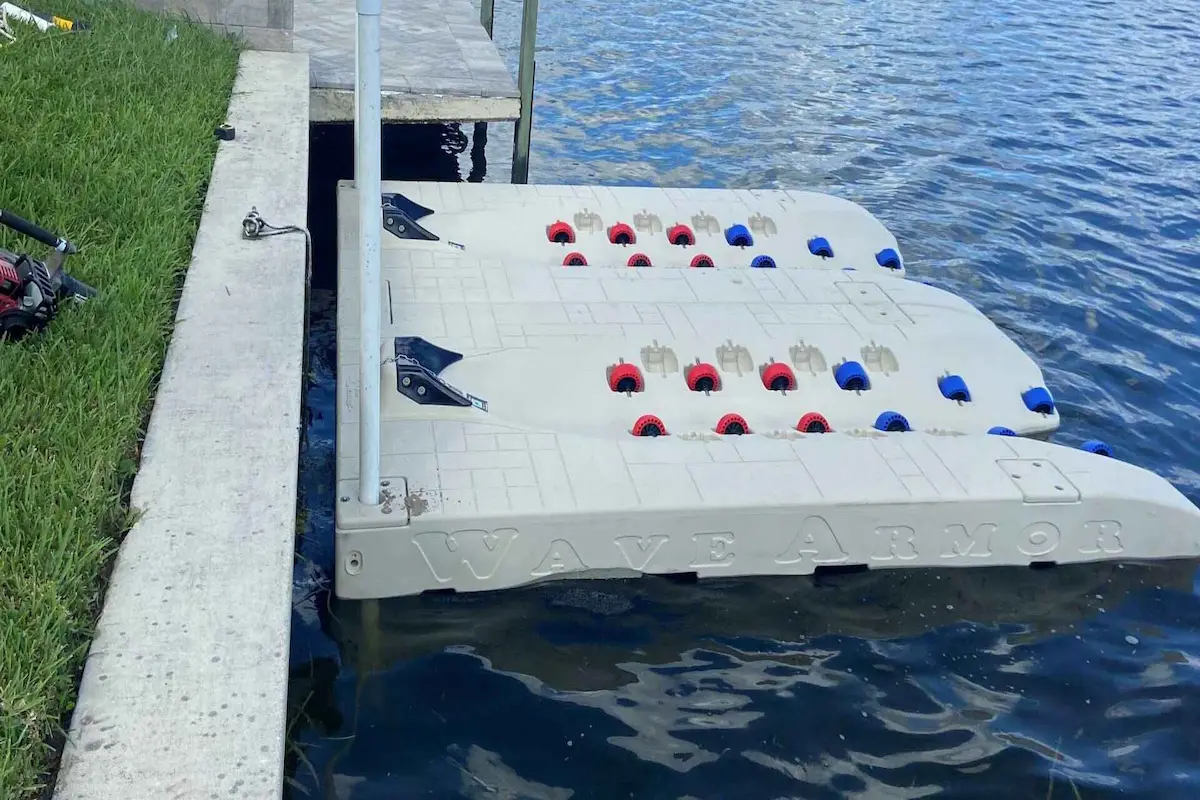
MacDuff Marine’s Wave Armor installations can combine floating dock sections with dedicated drive-on PWC ports rather than treating the Jet Ski storage as an afterthought.
Appearance Is a Preference, Not a Performance Metric
The older article described Wave Armor as premium-looking and EZ Dock as a utility product. That is subjective and unnecessary.
Wave Armor’s current Wave Dock sections use a molded flagstone-style surface and are commonly shown in its Pebble Beach finish.
EZ Dock also offers molded polyethylene surfaces and currently offers standard product colors such as beige and gray across portions of its lineup.
For a residential property, look at real installations and decide which surface, color, section proportions, and finished layout fit the home and waterfront.
Wave Armor vs. EZ Dock Warranty Comparison
This is where the old article was especially misleading. For the primary floating-dock sections, both Wave Armor and EZ Dock currently list a 10-year residential warranty. Connection, anchoring, accessory, and port warranty periods differ between the two brands, Wave Armor lists 2-year terms on H-beam connections, anchoring kits, and accessories, and 8-year terms on PWC, boat, and pontoon ports.
| Product Category | Wave Armor | EZ Dock |
|---|---|---|
| Floating Docks | 8 years residential | 10-year limited warranty |
| Dock Connections | 2 years for H-Beam connections | 1 year for dock connection kits |
| Dock Anchoring | 2 years for dock anchoring kits | 1 year for dock anchoring |
| Dock Accessories | Generally 2 years; solar lights are an exception | Generally 1 year |
The warranty documents also contain exclusions. Severe weather, improper installation, misuse, modifications, impacts, and other conditions can affect coverage depending on the manufacturer and claim.
Review the current Wave Armor warranty and current EZ Dock warranty before using warranty length as the deciding factor.
Which System Costs More?
A responsible comparison cannot give one universal percentage or installed-price range.
The final cost depends on the number and size of dock sections, PWC or boat ports, connection hardware, anchoring or mounting system, gangway or shore access, accessories, delivery, installation, permitting requirements, and conditions at the property.
The previous article included installed-price ranges for both brands without enough support. Those numbers have been removed.
What Actually Matters in Southwest Florida?
Brand is only one part of the decision. A good floating dock system can still be poorly suited to a property if the configuration, connection method, or anchoring approach is wrong.
Water Depth
Depth and bottom conditions can influence mounting and access options.
Changing Water Levels
One advantage of both systems is that the floating surface follows changes in water elevation.
Watercraft
Boats, PWCs, kayaks, canoes, and swimming access should influence the layout from the beginning.
Existing Structures
Seawalls, fixed docks, pilings, and neighboring waterfront features can affect the project.
Permitting
Requirements vary by location and project scope and should be confirmed for the property.
Local Support
Product availability, installation experience, replacement parts, and ongoing dealer support can be as important as a specification-sheet difference.
Is Wave Armor or EZ Dock Better in a Hurricane?
We would not make a blanket claim that either floating dock is “hurricane-proof” or that one manufacturer will always outperform the other during a hurricane.
Severe weather can create extreme wind, waves, surge, debris impacts, unusual water levels, and loads on anchors and surrounding structures. Performance depends on much more than the brand name molded into the dock section.
Both manufacturers exclude at least some forms of severe-weather or external damage from warranty coverage, so hurricane performance should not be inferred from warranty length.
When Wave Armor Makes Sense
Wave Armor is worth strong consideration when you are starting a new waterfront project and want a system built around its current dock, port, and accessory ecosystem.
- You prefer the foam-filled lower-float construction.
- You want Wave Armor’s H-Beam connection architecture.
- You want to incorporate Wave Armor PWC, boat, pontoon, or kayak products.
- You prefer Wave Armor’s flagstone-style deck appearance.
- You want a local installer that regularly works with Wave Armor.
- You want the dock layout designed as part of a broader MacDuff Marine waterfront project.
When EZ Dock May Make Sense
There are also legitimate situations where staying with or choosing EZ Dock deserves consideration.
- You already have an EZ Dock installation that is in good condition.
- Your planned expansion works naturally with compatible EZ Dock sections.
- You prefer the foam-free hollow-chamber construction.
- You prefer EZ Dock’s flexible rubber coupler architecture.
- You need a particular EZ Dock launch, gangway, accessibility, or accessory configuration.
- You already have trusted local support for that product system.
Replacing a working system solely because another brand exists rarely makes sense without looking at the condition, expansion goals, compatibility, and total project cost.
Why We Usually Recommend Wave Armor for New Projects
MacDuff Marine is an authorized Wave Armor dealer. We know the Wave Armor product system, install it, and can plan the dock together with compatible PWC ports, boat ports, kayak access, and dock accessories.
That local product familiarity is the primary reason we generally lead with Wave Armor on new floating-dock projects. It allows the conversation to move beyond “which plastic dock is better?” and into the more useful question of how the entire waterfront should work.
You can explore Wave Armor floating docks, view completed waterfront projects, or read customer reviews.
Wave Armor vs. EZ Dock Questions
Which has the longer floating-dock warranty, Wave Armor or EZ Dock?
They differ: Wave Armor currently lists an 10-year residential warranty for floating docks, while EZ Dock currently lists a 10-year limited warranty for floating docks. Their connection, anchoring, accessory, and port warranty periods can also differ.
Are Wave Armor and EZ Dock made from the same material?
Both use rotomolded polyethylene construction, but the dock-section designs differ. Wave Armor uses a two-piece design with a foam-filled lower float. EZ Dock uses foam-free hollow flotation chambers in an integrated rotomolded section.
How do Wave Armor and EZ Dock connect their dock sections?
Wave Armor uses polyethylene H-Beams that slide into molded channels on compatible dock sections. EZ Dock uses flexible recycled-rubber couplers designed to allow some independent movement between sections while maintaining overall stability.
Does EZ Dock offer PWC and kayak products?
Yes. EZ Dock currently offers several PWC port products as well as EZ Launch kayak and canoe systems. Wave Armor also offers multiple PWC port configurations, boat and pontoon ports, and kayak-access products.
Is Wave Armor more hurricane-resistant than EZ Dock?
We would not make that blanket claim. Severe-weather performance depends on the dock configuration, anchoring, surrounding structures, water conditions, debris, and other site-specific factors. Neither system should be represented as hurricane-proof.
Which dock requires less maintenance?
Both manufacturers market their polyethylene systems as low maintenance. Neither should be treated as maintenance-free. Dock surfaces, connections, anchoring components, ports, and accessories should still be cleaned and inspected according to manufacturer guidance and site conditions.
Can Wave Armor and EZ Dock sections connect directly together?
Their primary dock-section connection systems are different and should not be assumed to connect directly. If a property needs a transition between different systems, compatibility and any appropriate adapter or transition solution should be evaluated for the specific products involved.
Why does MacDuff Marine recommend Wave Armor?
MacDuff Marine is an authorized Wave Armor dealer and regularly works with the Wave Armor dock, port, and accessory system. For new Southwest Florida projects, that product familiarity and local installation support are important reasons MacDuff Marine generally recommends Wave Armor.
Related Reading
Pontoon Boat Lift Sizing and Selection Guide for Southwest Florida

Boat Lift Cable Replacement: When, Why, and How Much in Southwest Florida

Also see the Dock Lighting Buyer’s Guide for Southwest Florida and the Mooring Whips Complete Buyer’s Guide for Cape Coral and SW Florida.
Planning a New Floating Dock in Southwest Florida?
Send MacDuff Marine photos of the waterfront and tell us what boats, PWCs, kayaks, swimming access, or other features the finished dock needs to support. We can help determine whether a Wave Armor layout makes sense for the property. Get a Free Dock Estimate or explore Wave Armor docks, or call or text (239) 872-4300.